Building a Personal Shortlist That Stays Useful
A saved list decays quietly. Entries accumulate, none of them are ever opened again, and after a season the list describes your curiosity in month one rather than your taste now. Four maintenance rules fix it, and they cost very little: a twelve-minute review once a month adds up to 144 minutes a year, which is 2.4 hours against the 192 hours a year that a full hour of chat four times a week would take.

Key takeaways
- Cap the list. Twenty entries you can describe from memory beat forty you cannot, and the cap forces the pruning decision.
- Save with a reason attached. One line about the tone you wanted turns a name into something you can search for again.
- A monthly review costing about twelve minutes is 144 minutes a year, around 1.3 percent of the time a 16-session month consumes.
- Prune using behaviour, not approval: an entry nobody opened in a month is a candidate for removal regardless of how good its description reads.
Why lists rot
The problem is that saving is free and reviewing is not. Each save costs a click, and each removal requires a judgement, so the cheap action happens far more often than the expensive one. The result is a list that grows monotonically while the time available to use it stays flat.
Growth is also uneven. A reader who adds three entries in a good week and removes none has a list that reflects their busiest week rather than their steady preference. Six months of that pattern produces a list nobody would have chosen deliberately.
And there is a hidden cost in search. Once the list passes a few dozen entries, finding a specific character takes scrolling, which is exactly the work the list was supposed to save. A shortlist that is slower to use than the site's own search has stopped functioning as a shortlist.
Four rules that keep it working
The rules below are deliberately mechanical. Their value is that they can be applied in a few minutes without deliberation, which is the only reason a maintenance habit survives contact with a busy month.
| Rule | Trigger | What you do | Typical cost |
|---|---|---|---|
| Save with a reason | Any time you keep a character | Write one line about the tone you wanted | About 20 seconds per save |
| Cap the total | The list reaches your limit, say 20 entry points | Remove the least-opened entry before adding a new one | One comparison, no writing |
| Review monthly | The first week of each month | Open the list, delete anything unopened for a month | About 12 minutes, or 144 minutes a year |
| Group by use | When two entries serve the same mood | Keep the better one and label the survivor | A minute, once per duplicate pair |
Worked example: one year of a 20-entry list
Start month one with 20 entries. In a typical undertaking, assume three additions and two removals a month — the additions come from browsing, and the removals come from the monthly review. The net change is one entry a month, so the list ends month twelve at 32 entries if nothing else changes, which is already past the twenty the rules suggest.
Apply the cap instead and the arithmetic changes character. Each month adds three and removes three, the total stays at 20, and the composition turns over completely in under seven months — three additions a month against a fixed total of 20 means the entire list is replaced roughly every 6.7 months if the additions are genuinely new. The list stops growing and starts tracking.
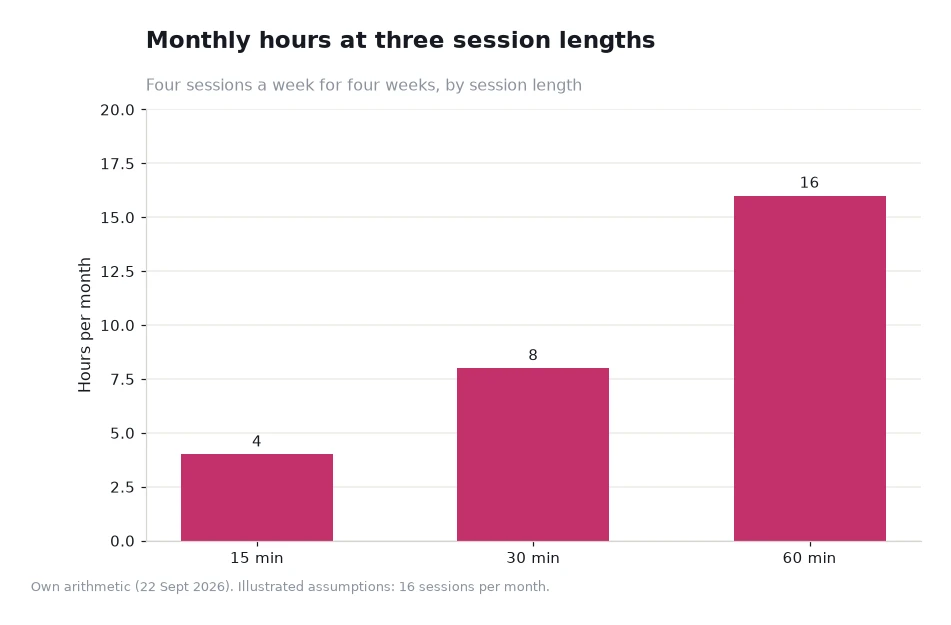
Now put time against the maintenance. Twelve minutes a month is 144 minutes a year, or 2.4 hours. A reader who chats four times a week for a full hour each session spends 16.0 hours a month in conversation, which is 192 hours over a year. The review is roughly 1.3 percent of that total, and every one of those minutes is spent removing entries that would otherwise cost you scrolling every week.
Choosing what earns a place
A shortlist is a ranking, so it needs a ranking rule. The published card counters offer one model: the busiest cards on the Crushon trends board show how differently reach and deliberate saves behave, with figures such as 7.1K favourites against 24.3M views on one card and 2.8K against 19.1M on another. Those are site-wide numbers, not yours, but the distinction they illustrate is the one to copy — separate what you looked at from what you chose. Crushon's own FAQ introduces the service as Porn Chat AI and answers four questions about realism, restrictions and customisation, which is the right level of detail for deciding whether to keep an entry.
Apply it by keeping a single line beside each entry: what you opened it for. Over a few months the lines cluster, and the clusters tell you which characters are genuinely distinct and which are three versions of the same mood. The duplicates are the easiest removals on the list.
Finally, keep a replacement route open. When you remove an entry, note the tag or the keyword that produced it, so filling the gap takes a filter rather than an afternoon. The character search page and the weekly rankings make that quick, and the page for the porn ai chat service explains how saved characters and remembered preferences carry forward between visits.
What good looks like after six months
A healthy list has four properties. It fits on one screen. Every entry has a reason written next to it. Nothing on it has gone unopened for two months. And you can describe any entry from memory well enough to know why it is there rather than three others.
None of those properties requires discipline in the sense of willpower. They require a rule applied on a fixed day, which is why the monthly review matters more than any individual decision. The review is the mechanism that keeps a list honest, and twelve minutes a month is a low price for a library that behaves like a filter instead of an archive.
Frequently asked questions
How many characters should a shortlist hold?
Enough that each one gets opened occasionally and few enough that you can still recall why each is there. Twenty is a workable figure for most readers, and the exact number matters less than having one.
Is it worth deleting a character I might want later?
Yes, if you have written down the tag or keyword that found it. Finding it again through search costs less than scrolling past it every week for a year.
Should the review be monthly or weekly?
Monthly is usually enough, because taste moves slower than browsing. Review weekly only in the first two months, while you are still working out which tags you actually follow.
Set the cap and hold it
Pick a number, put it in a note, and treat it as the list's size. Then schedule the review on a date that recurs, such as the first Monday of the month, and do the deletions before you do any browsing. Order matters: pruning first prevents the review from becoming another saving session.
After two months the list stops feeling like work. You will open it, remove two entries, and get on with the scene you actually came for — which was the point of keeping a shortlist at all.
Data and sources: FAQ wording and service description on the platform's adult chat page[1], with filters, trending tags and the Thursday weekly rankings on the character search page[2]. Counters were read on 22 Sept 2026; the list-size and review arithmetic are worked examples rather than platform data. Created for adults 18 and over; read 22 Sept 2026.